
Abstract
Objective
With this study, we aimed to establish the relation of the triglyceride/glucose index with the severity of coronary artery disease in the patients who underwent percutaneous coronary intervention after having been hospitalized in cardiology clinic upon applying to the emergency service with angina pectoris.
Material and Methods
This study was performed on 416 patients who applied to the Emergency Service of Ufuk University Faculty of Medicine Dr. Rıdvan Ege Hospital, with angina pectoris symptom between 01.01.2018 and 31.12.2021. Patients’ triglyceride/glucose index on the date when coronary angiography was performed was calculated by scanning the laboratory workups retrospectively. The coronary angiography reports of the patients were scanned and SYNTAX score was calculated.
Results
The age average of 416 patients who were included into the study is 61.74±11.21 (minimum: 35-maximum: 89). 66.3% of the patients were male and 9.6% were in the high risk group according to the SYNTAX score. TyG index increases by SYNTAX risk group, TyG index of those who were ranked in the SYNTAX high-risk group were found higher than low and moderate risk group (p<0.001). There is a positive moderate-range correlation between the SYNTAX score and TyG index (r=0.595, p<0.001). It was found that the variable mostly contributing into the model in the multiple linear regression analysis created in order to establish the SYNTAX score was TyG index, it accounts for 33.9% of the variation in the SYNTAX score. A one unit increase in TyG index leads to an increase of 19.71 in SYNTAX score. According to the results of our study, the cut-off value we suggested is 5.21 (sensitivity: 80%, specificity: 85%).
Conclusion
According to the results of our study, TyG index is a parameter which can be used in the prediction of SYNTAX score and severity of the disease (high-risk estimate) in the patients applying with angina pectoris.
Keywords: ACS, angina, TyG index, triglyceride/glucose index, SYNTAX
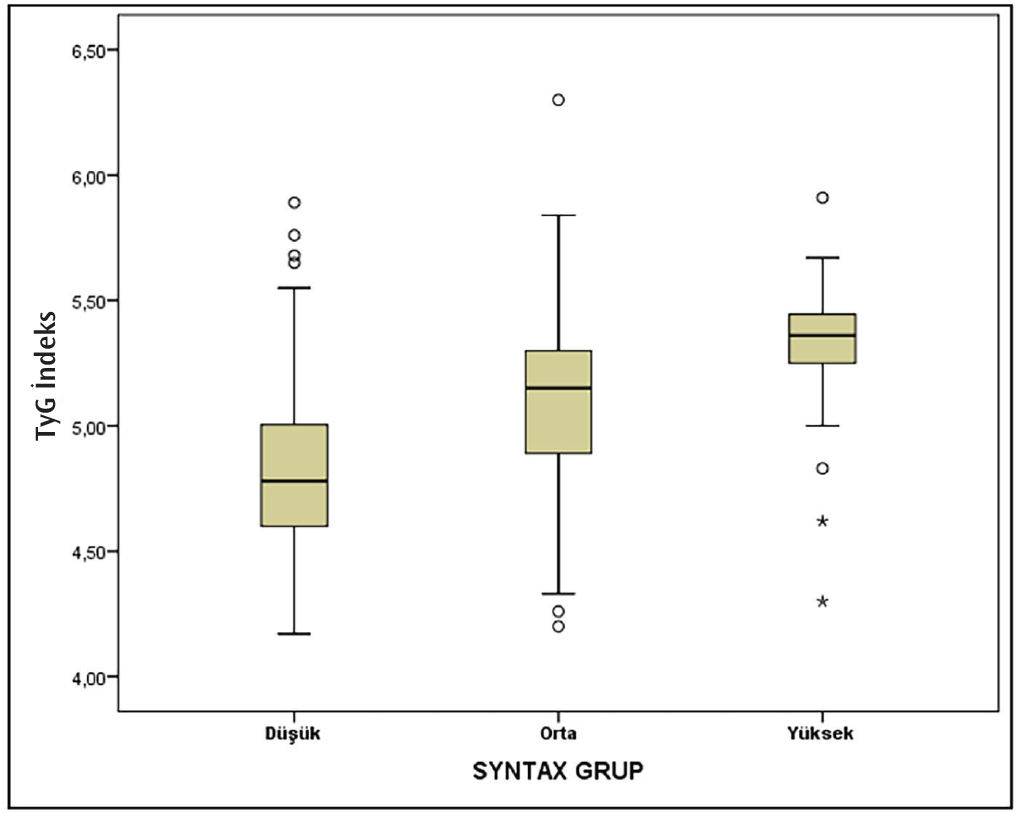
TyG: Trigliserit/glukoz
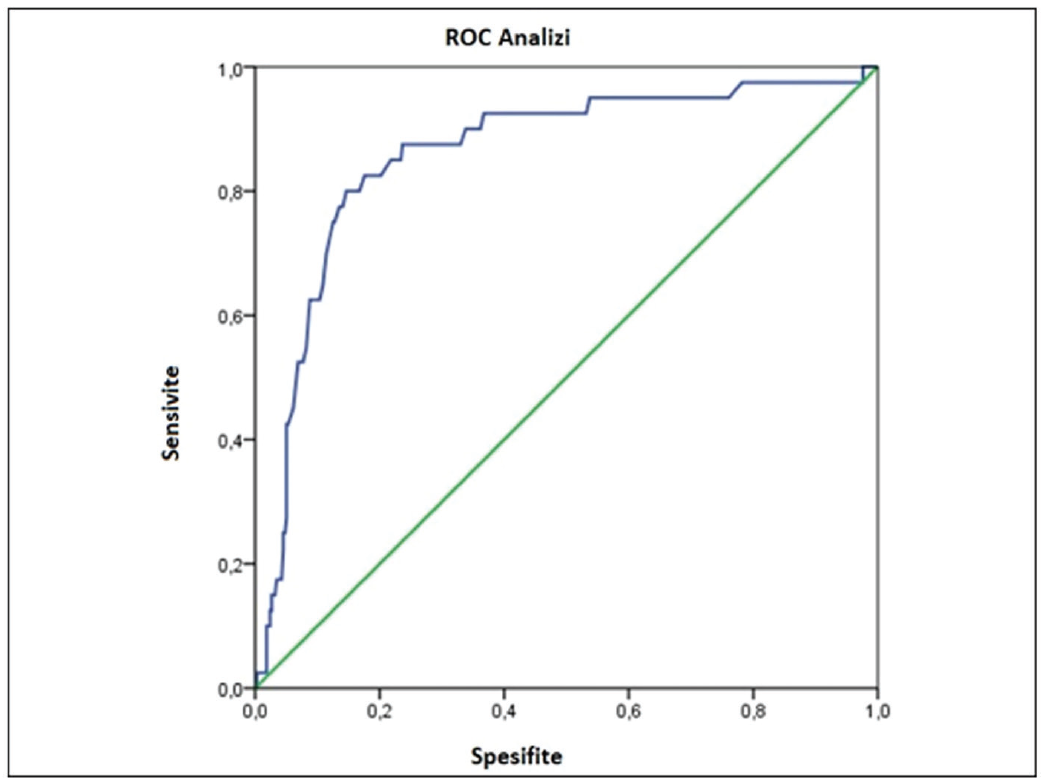
ROC: Alıcı işletim karakteristik eğrisi
References
World Health Organization WHO (2022) [cited 24 Jan 2022]. Available from: https://www.who.int/health-topics/cardiovascular-diseases#tab=tab_1
Yusuf S, Hawken S, Ounpuu S, Dans T, Avezum A, Lanas F, et al. Effect of potentially modifiable risk factors associated with myocardial infarction in 52 countries (the INTERHEART study): case-control study. Lancet. 2004;364(9438):937-952.
Ceylan Y, Kaya Y, Tuncer M. Determination of risk factors in patients with acute coronary syndrome. Van Tıp Dergisi. 2011;18(3):147-154.
Schmidt MI, Duncan BB, Bang H, Pankow JS, Ballantyne CM, Golden SH, et al. Identifying individuals at high risk for diabetes: The atherosclerosis risk in communities study. Diabetes Care. 2005;28(8):2013-2018.
Jin JL, Cao YX, Wu LG, You XD, Guo YL, Wu NQ, et al. Triglyceride glucose index for predicting cardiovascular outcomes in patients with coronary artery disease. J Thorac Dis. 2018;10(11):6137-6146.
Eckel RH, Grundy SM, Zimmet PZ. The metabolic syndrome. Lancet. 2005;365(9468):1415-1428.
Kim MK, Ahn CW, Kang S, Nam JS, Kim KR, Park JS. Relationship between the triglyceride glucose index and coronary artery calcification in Korean adults. Cardiovasc Diabetol. 2017;16(1):108.
Lee SB, Ahn CW, Lee BK, Kang S, Nam JS, You JH, et al. Association between triglyceride glucose index and arterial stiffness in Korean adults. Cardiovasc Diabetol. 2018;17(1):41.
Irace C, Carallo C, Scavelli FB, De Franceschi MS, Esposito T, Tripolino C, et al. Markers of insulin resistance and carotid atherosclerosis. A comparison of the homeostasis model assessment and triglyceride glucose index. Int J Clin Pract. 2013;67(7):665-672.
Wang L, Cong H, Zhang J, Hu Y, Wei A, Zhang Y, et al. Triglyceride-glucose index predicts adverse cardiovascular events in patients with diabetes and acute coronary syndrome. Cardiovasc Diabetol. 2020;19(1):80.
da Silva A, Silva Caldas APS, Miranda HHH, Bersch-Ferreira AC, Ragne TC, Weber B, et al. Triglyceride-glucose index is associated with symptomatic coronary artery disease in patients in secondary care. Cardiovasc Diabetol. 2019;18(1):89.
Neumann F-J, Sousa-Uva M, Ahlsson A, Alfonso F, Banning AP, Benedetto U, et al. 2018 ESC/EACTS Guidelines on myocardial revascularization. European Heart Journal. 2018:40(2):87-165.
Luo E, Wang D, Yan G, Qiao Y, Liu B, Hou J, et al. High triglyceride-glucose index is associated with poor prognosis in patients with acute ST-elevation myocardial infarction after percutaneous coronary intervention. Cardiovasc Diabetol. 2019;18(1):150.
Mao Q, Zhou D, Li Y, Wang Y, Xu SC, Zhao XH. The triglyceride-glucose index predicts coronary artery disease severity and cardiovascular outcomes in patients with non-ST-segment elevation acute coronary syndrome. Dis Markers. 2019;1:6891537.
Park K, Ahn CW, Lee SB, Kang S, Nam JS, Lee BK, et al. Elevated TyG index predicts progression of coronary artery calcification. Diabetes Care. 2019;42(8):1569-1573.
Lee EY, Yang HK, Lee J, Kang B, Yang Y, Lee SH, et al. Triglyceride glucose index, a marker of insulin resistance, is associated with coronary artery stenosis in asymptomatic subjects with type 2 diabetes. Lipids Health Dis. 2016;15(1):155.
Ma X, Dong L, Shao Q, Cheng Y, Lv S, Sun Y, et al. Triglyceride glucose index for predicting cardiovascular outcomes after percutaneous coronary intervention in patients with type 2 diabetes mellitus and acute coronary syndrome. Cardiovasc Diabetol. 2020;19(1):31.
Sánchez-Íñigo L, Navarro-González D, Fernández-Montero A, Pastrana-Delgado J, Martínez JA. The TyG index may predict the development of cardiovascular events. Eur J Clin Invest. 2016;46(2):189-197.
Li S, Guo B, Chen H, Shi Z, Li Y, Tian Q, et al. The role of the triglyceride (triacylglycerol) glucose index in the development of cardiovascular events: a retrospective cohort analysis. Sci Rep. 2019;9(1):7320.