
Abstract
Objective
We aimed to investigate the relationship between baselıne SYNTAX score (bSS) and residual SS (rSS) and in-hospital adverse major cardiovascular events (death, cerebrovascular events, etc.) in patients with diabetes mellitus (DM) who underwent percutaneous coronary intervention (PCI) for acute coronary syndrome (ACS).
Material and Methods
Between 1 June 2018 and 30 June 2019, 352 patients with DM who were hospitalised for ACS (ST elevation myocardial infarction, non-ST elevation myocardial infarction and unstable angina pectoris) and underwent PCI were included in our study. Demographic information, clinical history, epicrisis, laboratory-imaging results and recorded angiographic images of the selected patient group were obtained from the hospital electronic database system and patient files. bSS and rSS were calculated from the coronary angiography images of the patients recorded via the hospital electronic environment. In-hospital adverse events of the patients were recorded. Statistics were performed for the relationship between these recorded data and the calculated bSS and rSS and the data were transferred to the study.
Results
Insulin use and cardiac mortality were significantly associated with higher SS in diabetic patients. In univariate logistic regression analysis, bSS and rSS were statistically significant in predicting in-hospital mortality. In multivariate logistic regression analysis, bSS was significant in predicting in-hospital mortality, while rSS was not significant.
Conclusion
bSS and rSS can predict some of the in-hospital outcomes. High SS (bSS, p<0.001) was found to be significantly associated with the prediction of in-patient mortality.
Keywords: SYNTAX score, coronary artery disease, diabetes mellitus
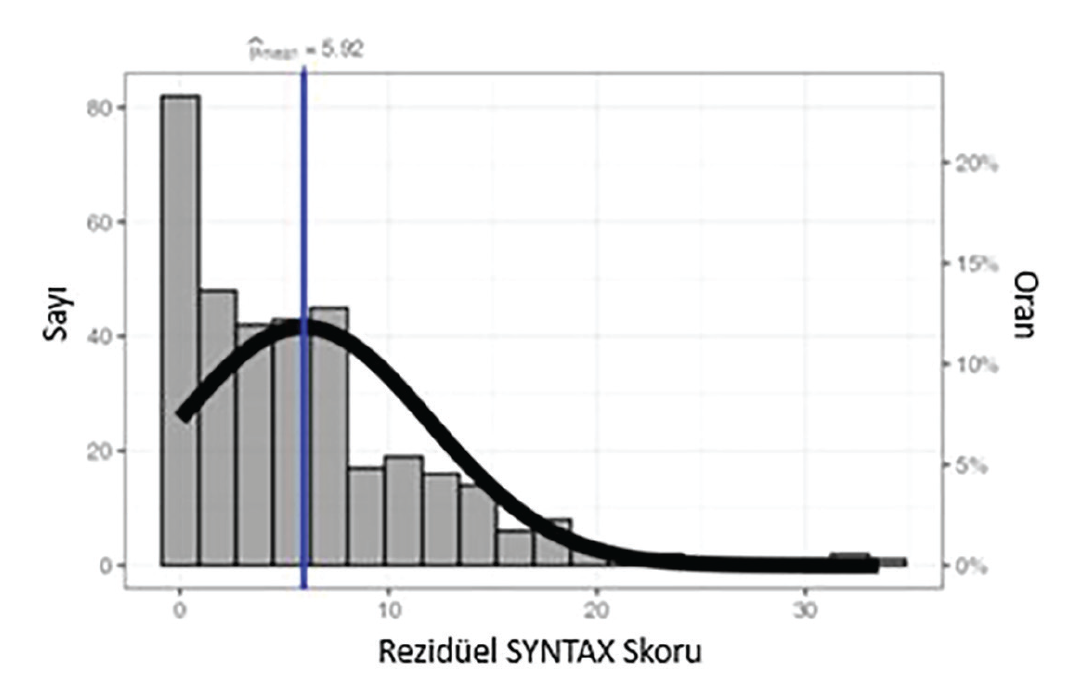
rSS: Rezidüel SYNTAX skoru
References
Singbal Y, Fryer M, Garrahy P, Lim R. Baseline and residual SYNTAX score in predicting outcomes after acute infarct angioplasty. EuroIntervention J Eur Collab Work Group Interv Cardiol Eur Soc Cardiol. 2017;12:1995-2000.
Braga CG, Cid-Alvarez AB, Diéguez AR, Alvarez BA, Otero DL, Sánchez RO, et al. Prognostic impact of residual SYNTAX score in patients with ST-elevation myocardial infarction and multivessel disease: Analysis of an 8-year all-comers registry. Int J Cardiol. 2017;243:21-26.
Lovic D, Piperidou A, Zografou I, Grassos H, Pittaras A, Manolis A. The growing epidemic of diabetes mellitus. Curr Vasc Pharmacol. 2020;18:104-109.
TurkStat Corporate [Internet]. 2022. Access address: https://data.tuik.gov.tr/Bulten/Index?p=Olum-ve-Olum-Nedeni-Istatistikleri-2019-33710
Çayır A, Turan M. Cardiac disorders related to diabetes mellitus. Ank Med J. 2015;15.
Roth GA, Mensah GA, Johnson CO, Addolorato G, Ammirati E, Baddour LM, et al. Global burden of cardiovascular diseases and risk factors, 1990-2019. J Am Coll Cardiol. 2020;76:2982-3021.
Knapp M, Tu X, Wu R. Vascular endothelial dysfunction, a major mediator in diabetic cardiomyopathy. Acta Pharmacol Sin. 2019;40:1-8.
File: Endothelial dysfunction Atherosclerosis.png - Wikimedia Commons [Internet]. 2022. Availabla from: https://commons.wikimedia.org/wiki/File:Endothelial_dysfunction_Atherosclerosis.png
Ross R. The pathogenesis of atherosclerosis: a perspective for the 1990s. Nature. 1993;362:801-809.
Zengin H. Pathogenesis of atherosclerosis. J Exp Clin Med. 2013;29:101-106.
Falk E. Pathogenesis of atherosclerosis. J Am Coll Cardiol. 2006;47(8 Suppl):7-12.
Saçlı H, Kara İ, Kırali MK. Focus on coronary atherosclerosis [Internet]. Atherosclerosis - Yesterday, Today and Tomorrow. IntechOpen. 2018.
Squadrito G, Cucinotta D. The late complications of diabetes mellitus. Ann Ital Med Int. 1991;6:126-136.
Hwang JK, Lee SH, Song YB, Ahn J, Carriere K, Jang MJ, et al. Response by Hwang et al to Letter Regarding Article, “Glycemic Control Status After Percutaneous Coronary Intervention and Long-Term Clinical Outcomes in Patients With Type 2 Diabetes Mellitus”. Circ Cardiovasc Interv. 2017;10:e005616.
Bağci A. The place of SYNTAX score in coronary artery disease. Süleyman Demirel University Health Science Derg. 2018;9:44-50.
SYNTAX Puanı [Internet]. 2022. Available at: https://syntaxscore.org/
Neumann FJ, Sousa-Uva M, Ahlsson A, Alfonso F, Banning AP, Benedetto U, et al. 2018 ESC/EACTS Guidelines on myocardial revascularization. Kardiol Pol. 2018;76:1585-1664.
Relationship between residual syntax score and in hospital outcomes in patients undergoing primary percutaneous intervention - PDF Free Download [Internet]. 2022. Available at: https://docplayer.biz.tr/35668534-Relationship-betweenresidual-syntax-score-and-in-hospital-outcomes-in-patients-undergoing-primarypercutaneous-intervention.htm
Aytemiz F. Perkütan koroner girişim veya cerrahi revaskülarizasyon uygulanmış çok damar koroner arter hastalarının SYNTAX skoruna göre sınıflandırılması ve her iki revaskülarizasyon yönteminin sonuçlarının retrospektif olarak karşılaştırılması. Dokuz Eylül Üniversitesi Tıp Fakültesi, 2012.
Zeng Y, Yang S, Wang X, Fan J, Nie S, Wei Y. Prognostic impact of residual SYNTAX score in patients with obstructive sleep apnea and acute coronary syndrome: a prospective cohort study. Respir Res. 2019;20:43.
Cardi T, Kayali A, Trimaille A, Marchandot B, Ristorto J, Hoang VA, et al. Prognostic value of ıncomplete revascularization after percutaneous coronary intervention following acute coronary syndrome: focus on CKD patients. J Clin Med. 2019;8:810.
Khan R, Al-Hawwas M, Hatem R, Azzalini L, Fortier A, Joliecoeur EM, et al. Prognostic impact of the residual SYNTAX score on in-hospital outcomes in patients undergoing primary percutaneous coronary intervention. Catheter Cardiovasc Interv Off J Soc Card Angiogr Interv. 2016;88:740-747.
Minamisawa M, Miura T, Motoki H, Kobayashi H, Kobayashi M, Nakajima H, et al. Prediction of 1-year clinical outcomes using the SYNTAX score in patients with prior heart failure undergoing percutaneous coronary intervention: sub-analysis of the SHINANO registry. Heart Vessels. 2017;32:399-407.
Kul S, Akgul O, Uyarel H, Ergelen M, Kucukdaglı OT, Tasal A, et al. High SYNTAX score predicts worse in-hospital clinical outcomes in patients undergoing primary angioplasty for acute myocardial infarction. Coron Artery Dis. 2012;23:542-548.